Please Rotate

This highly interactive engineering study requires a landscape or horizontal orientation to accurately render CAD logic and diagrams.

Swipe left or right to navigate once rotated.

BATTERY DOOR
SYSTEM

Interactive Instructions

Navigate

Left/Right Arrows or Controls

Deep Dive

Enter the full Image Gallery

Overview

Press G to enter Grid Mode

* terms & conditions: find 2 secrets.
Product Design Case Study
Arya | Roll No: 23/ME/069

COMPACT BATTERY DOOR
MECHANISM STUDY

A Comprehensive Mechanical Engineering Solution: From First-Principles Kinematic Analysis Through Iterative Concept Evaluation to a Final Bistable Push-Push Assembly for a Compact iPod-Style Consumer Electronics Battery Door.
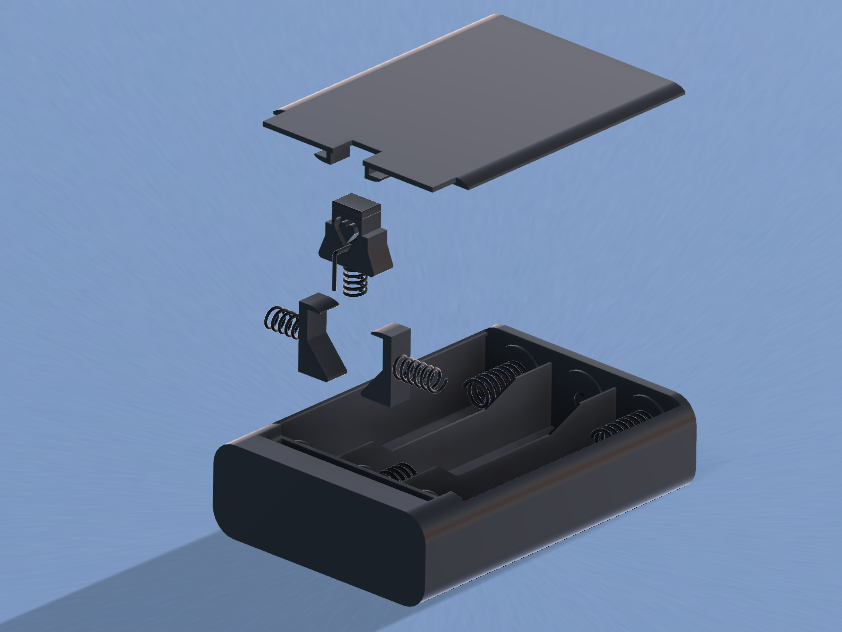
Full Model Rendered Exploded View

TABLE OF
CONTENTS

Interactive Document Map

01

PROBLEM
STATEMENT

The Compact Battery Door Mechanism

Context & Mandate

This project explores the design of a compact battery door mechanism for an iPod-style portable consumer electronics device. The design challenge: create a purely mechanical, normal-push battery door release system that fits inside a tight packaging envelope. The objective is to engineer a battery door mechanism housing 2 AA batteries (designed with scale considerations up to 3 AA), including a door, release button, and door latching features.

  • 1. Normal Actuation: A key mechanism requirement: a downward force on the button, normal to the door, should activate the button.
  • 2. Complete Housing: The button must reside fully within the mechanical outline of the battery door.
  • 3. Ejection Dynamics: The door should unlock when a user presses a button, causing the door to pop open in the opposite direction.
THE "HANDS-FREE" GOAL To make battery replacement effortless, our design introduces a "Service Mode" (Bistable locking). This allows the latches to hold open autonomously, freeing both hands for battery extraction.

DESIGN INSPIRATIONS

Benchmark Research & Existing Mechanism Borrowing

01 / Retractable Pens

Studied the cam and follower mechanisms of standard retractable ballpoint pens. The way a single push rotates a barrel to hold the tip out was a foundational inspiration for our bistable track approach.

02 / Push / Press Latches

Evaluated generic cabinet and electronic push-to-release latches. They rely on spring-loaded hooks that release via a heart-shaped groove path, confirming the viability of a cardioid track for state retention.

03 / Apple iPod

Benchmarked the structural assembly of legacy devices like the Apple iPod, looking specifically at how tightly-packed internal battery structures manage compressive forces and case snapping.

04 / Pincer Snap Fits

Analyzed pincer snap-fit designs for high-retention strength. The cantilever deflection and return angles found in strong pincers informed the geometric layout of our lateral micro-latches.

05 / SD Card Slots

Reviewed self-locking push-push SD card mechanisms. The tactile feedback (click-in, click-out) of these slots is exactly the premium haptic response targeted for the device door button.

"There is zero shame in borrowing architecture that has solved interaction paradigms for decades."

DESIGN CONSTRAINTS

01 /

Volumetric Sandbox

The entire mechanism is rigidly confined to a 38 × 15 × 10 mm internal void. The 13.5 mm cantilever arm utilizes 90% of the 15 mm Y-axis, leaving only 1.5 mm for chassis walls.

02 /

High-Capacity (3-Cell) Variant

While the initial brief specified a 2-cell array, this study explores a High-Capacity (3-cell) Modular Variant. This stresses the Inverted Cardioid mechanism under a max load of 32.64 N. The architecture offers a 50% runtime boost while preserving constraints.

03 /

Purely Mechanical

No electronic solenoids (parasitic drain on E-Reader battery). No sliding tabs (violates "seamless aesthetic" mandate). Material: PC/ABS Bayblend FR110 — high impact resistance, UL94 V-0, injection moldable.

TARGET COST: ₹47.00 per subassembly  |  ACTUATION BENCHMARK: 7.93 N (tunable to 11.5 N premium feel via spring swap)  |  NOTE: All kinematic calculations, FEA shear margins, and BOM reflect this optimized 3-cell configuration.

CONCEPT SKETCHES

Hand-Drawn Mechanism Ideation — Iterative Path to Final
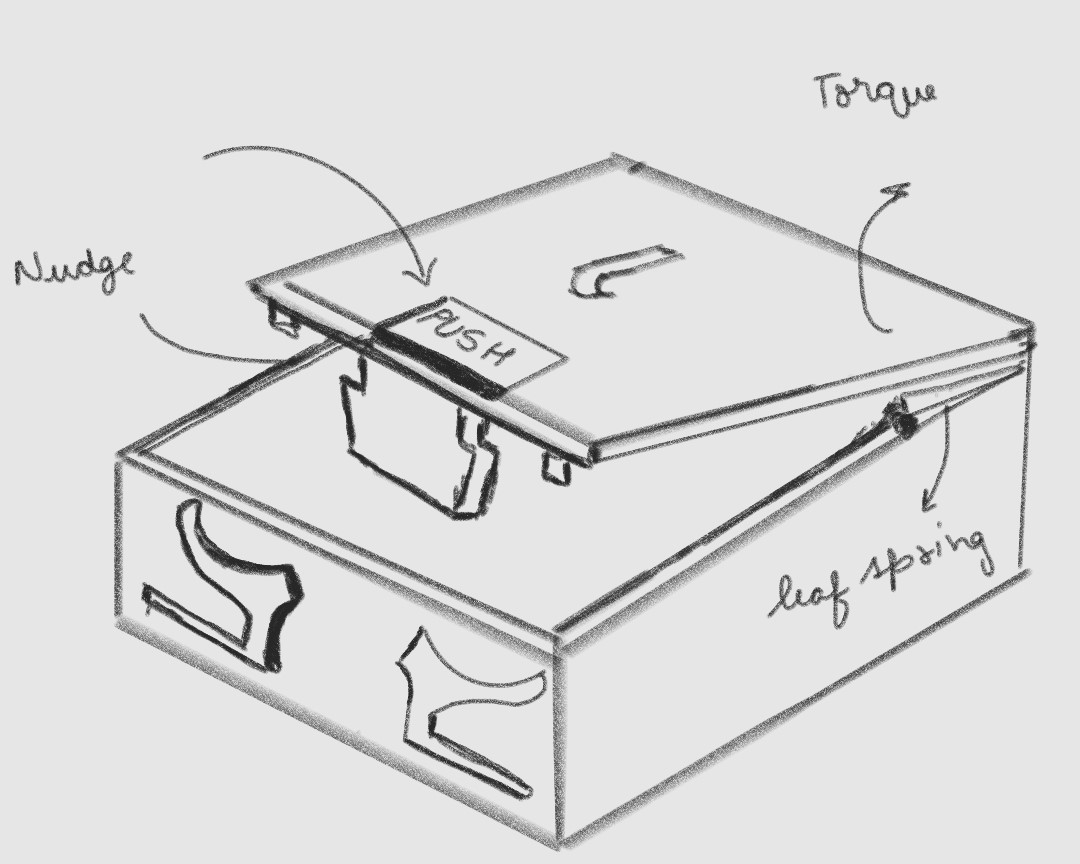
Flat Prong Concept

A1: Flat Prong

  • Nudge-torque ejection with flat cantilever prongs
  • Good conceptually but only offers momentary action
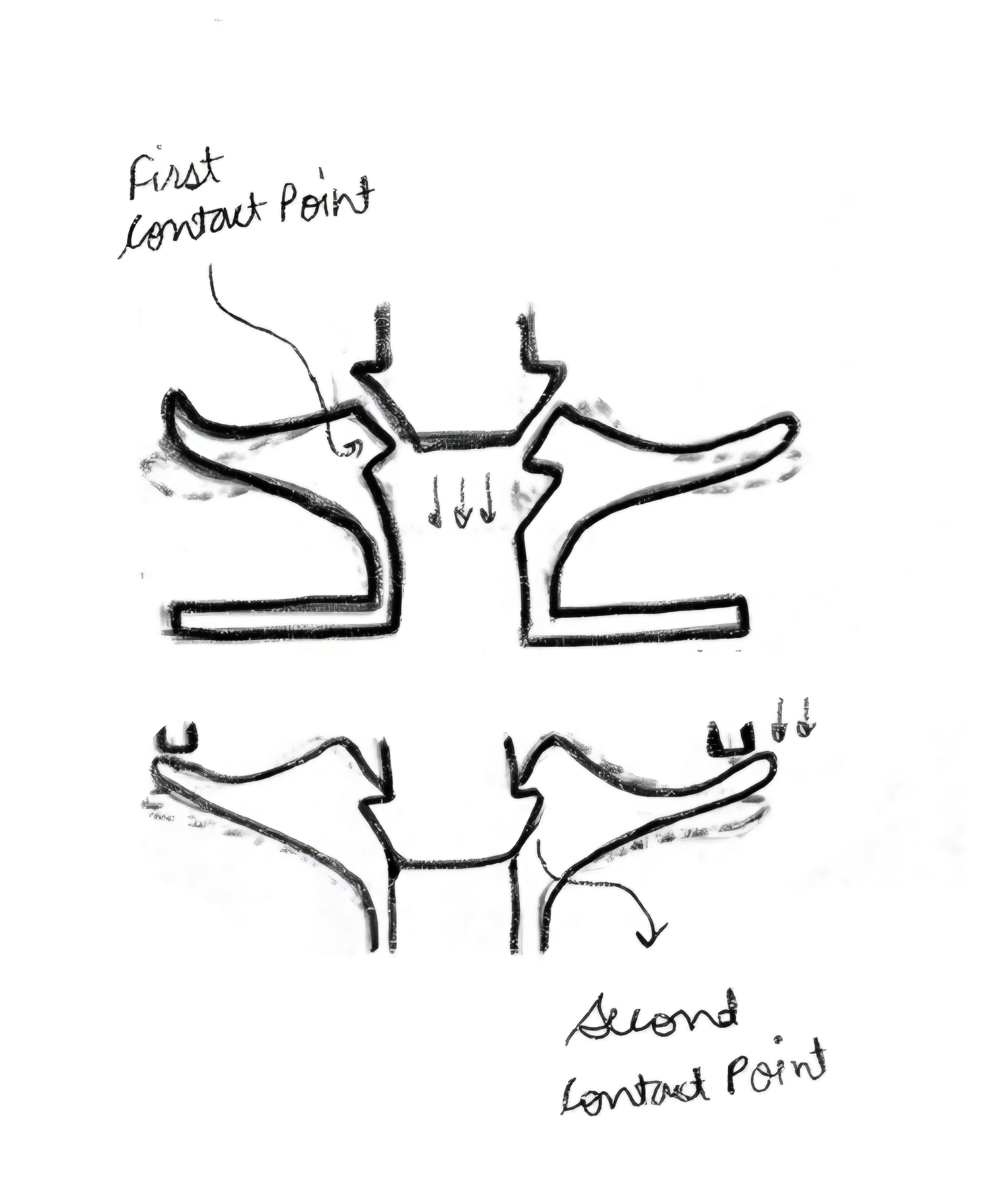
Dual Contact Concept

A2: Dual Contact

  • Two-stage progressive engagement
  • Solves timing issues of A1 but remains momentary-only
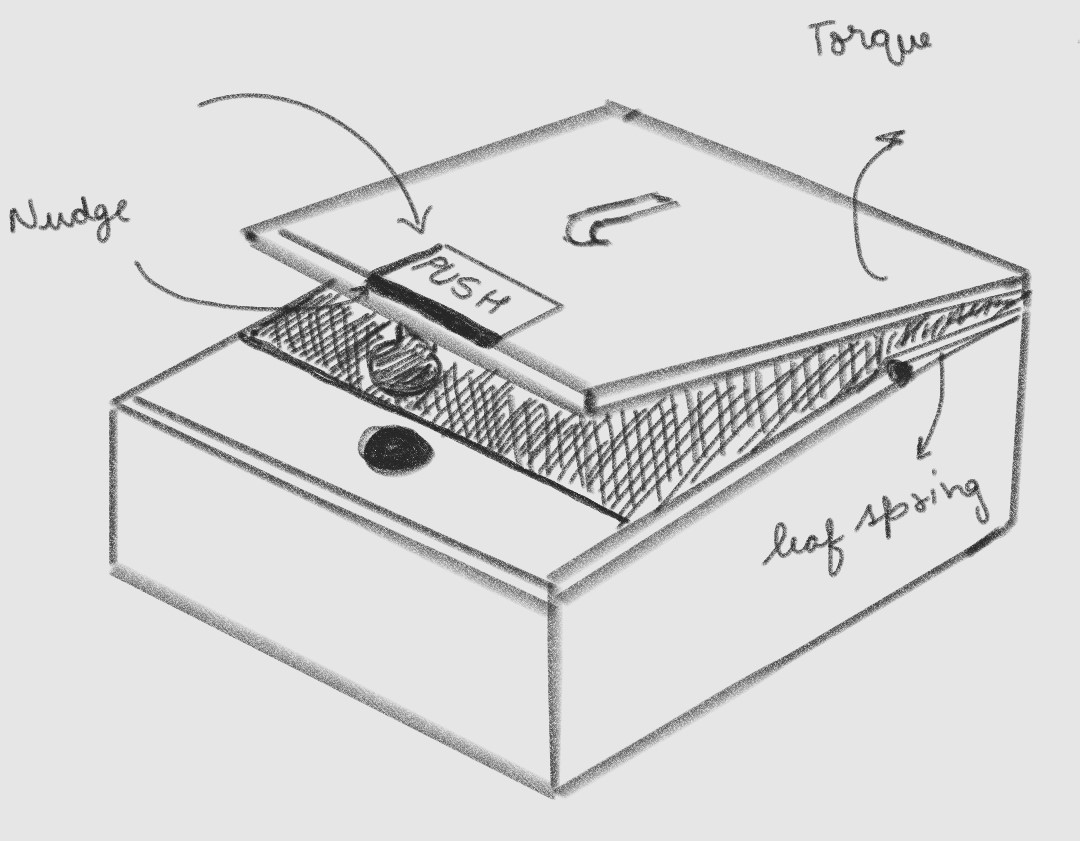
Spherical Ball Concept

B: Spherical Wedge

  • Rolling ball contact instead of sliding prongs to reduce friction
  • Poor state retention and difficult assembly
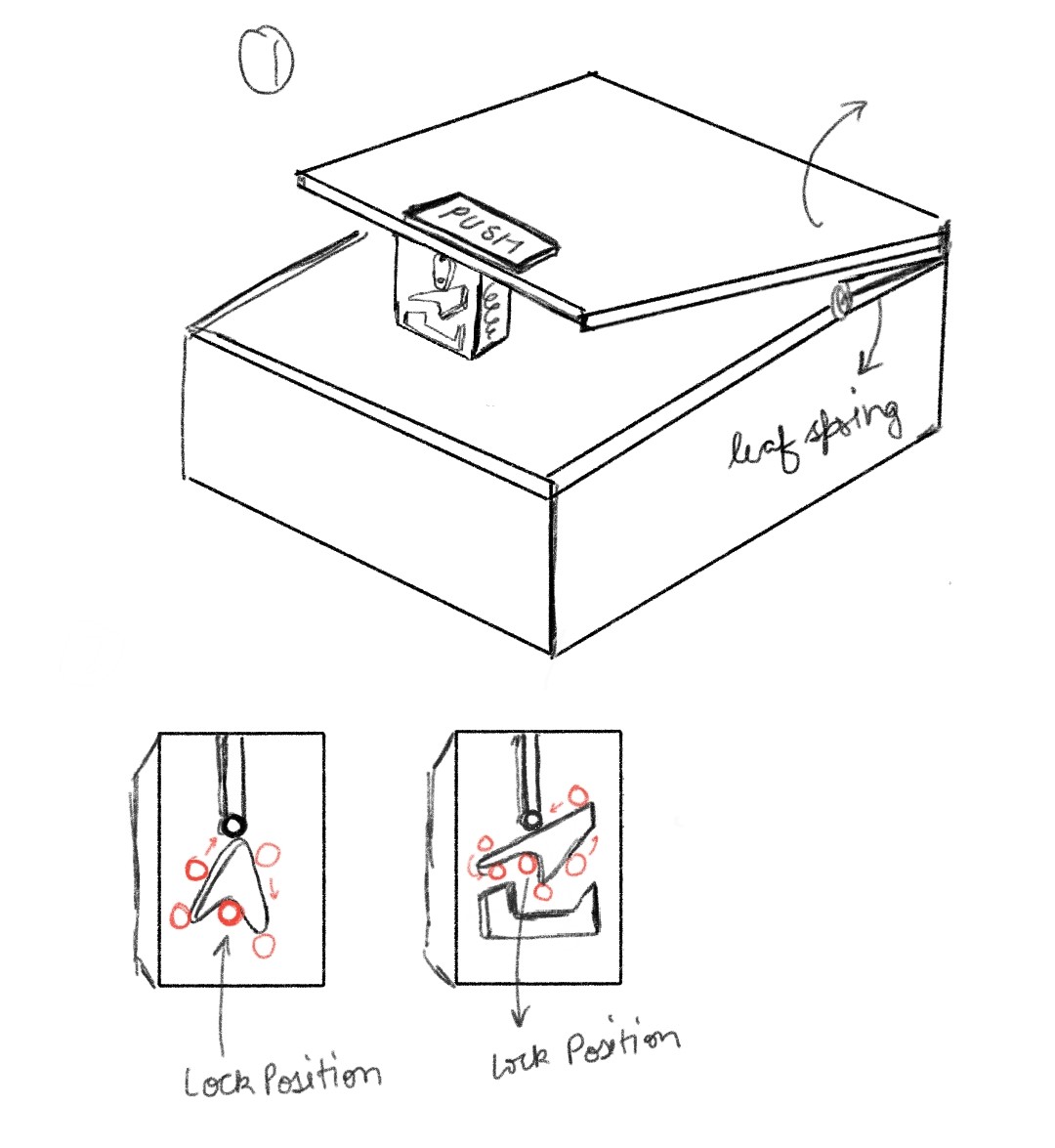
Cardioid Groove Concept

C: Groove Study

  • Mapped out the autonomous bistable lock/unlock track logic
  • Enables the "Service Mode" hands-free functionality
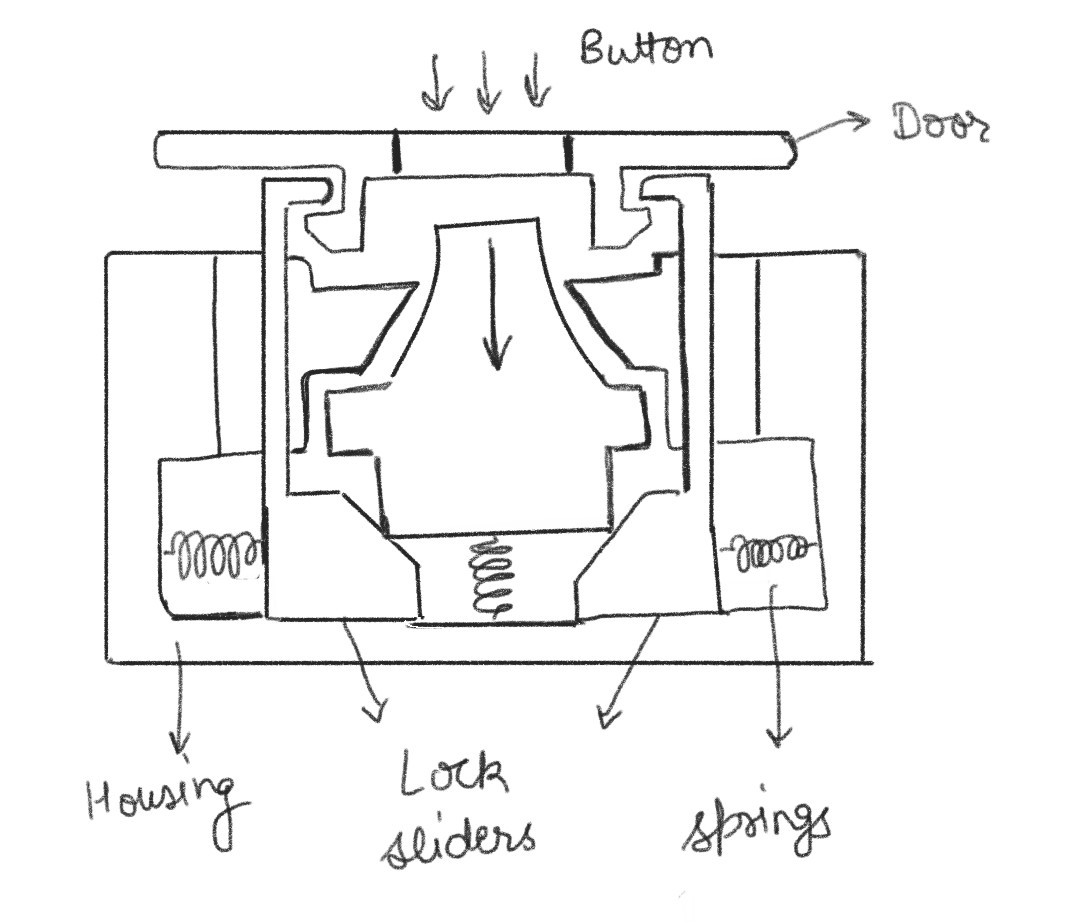
Final Model Sketch

D: Final Mech

  • Integrates vertical wedge geometry with lateral springs
  • Cardioid track for true hands-free service mode

EXHAUSTIVE TOPOLOGY EVALUATION

MechanismActuationBistable?Z-HeightVerdict
Sliding Tab LatchLateralNoLowREJECTED — requires lateral force, violates normal-push mandate
Magnetic CatchPull/PryNoLowREJECTED — no push-button actuation, no ejection force
Cam / Rotary LatchRotary TurnNoHighREJECTED — rotary motion violates constraint, excessive Z-depth
Electronic SolenoidPush (Switch)YesMedREJECTED — parasitic battery drain, high BOM cost
Rocker / Pivot AxleNormal PushNoHighCANDIDATE — reliable but fails Z-height and bistable requirements
A: Flat Prong WedgeNormal PushNoExcellentCANDIDATE — great Z-height but no Service Mode capability
B: Spherical Ball WedgeNormal PushNoGoodCANDIDATE — low friction but poor state retention under vibration
C: Dual-Contact ProngNormal PushNoGoodCANDIDATE — improved engagement feel but still momentary-only
D: Push-Push Cardioid ★Normal PushYESExcellentSELECTED — only topology fulfilling all constraints

DECISION TREE:
PUGH MATRIX

CriteriaWtFlat ProngBall WedgeDual ContactCardioid
Hands-Free (Bistable)51115
State Identification51125
Z-Height Efficiency44344
Tactile Ergonomics43245
Wear Resistance33233
DFM / Moldability34234
TOTAL584062102

Why The
Cardioid?

The Cardioid Push-Push mechanism is the only topology capable of physically holding the lateral clamps open autonomously, fulfilling the critical "hands-free" user mandate.

All other candidates score zero on the two highest-weighted criteria (Bistable & State ID, weight=5 each), making the Cardioid's 102-point total mathematically unassailable regardless of how the remaining criteria are tuned.

COMPONENT BREAKDOWN

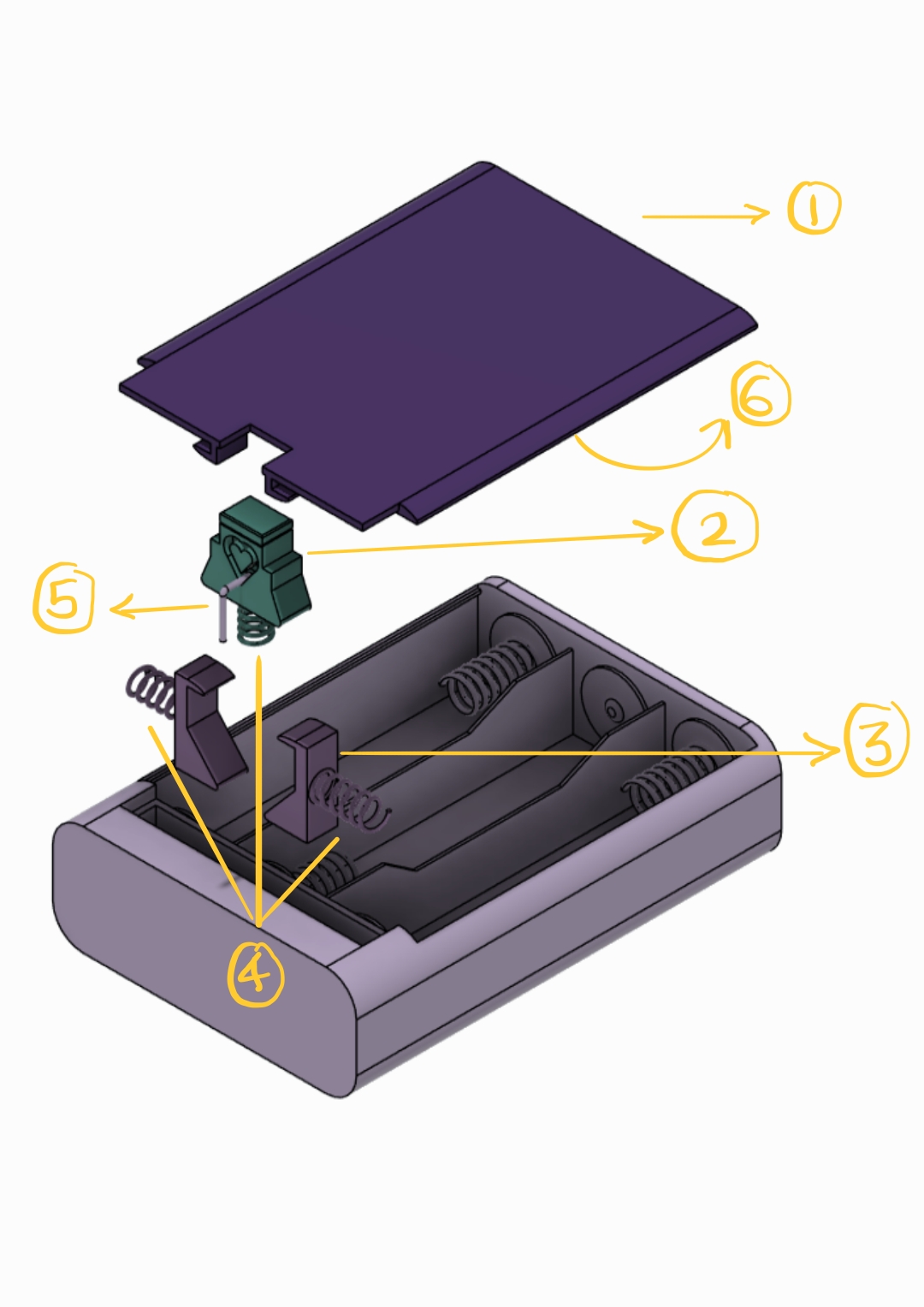
Every component in the battery door assembly, with its engineering purpose, material specification, and critical dimensions.

01 — Door

10% GF PC/ABS. Primary structural panel with rigid molded hooks. Houses mechanism, serves as seamless exterior.

02 — Wedge Button

PC/ABS. Translates Z-axis force into lateral latch retraction via 22.5° wedges. Houses cardioid heart-track.

03 — Micro-Latches (×2)

10% GF PC/ABS. Flexible sliding cantilever blocks engaging the hooks. They flex outward and do the locking work.
Component Breakdown

04 — Springs (×3)

High-Carbon Wire. 1× vertical return spring + 2× lateral coil springs (8.0N total). Drives reset snap and biasing.

05 — Follower Pin

304 SS Wire. Rides inside heart-track. Stepped depths ensure unidirectional travel. The mechanism's state machine.

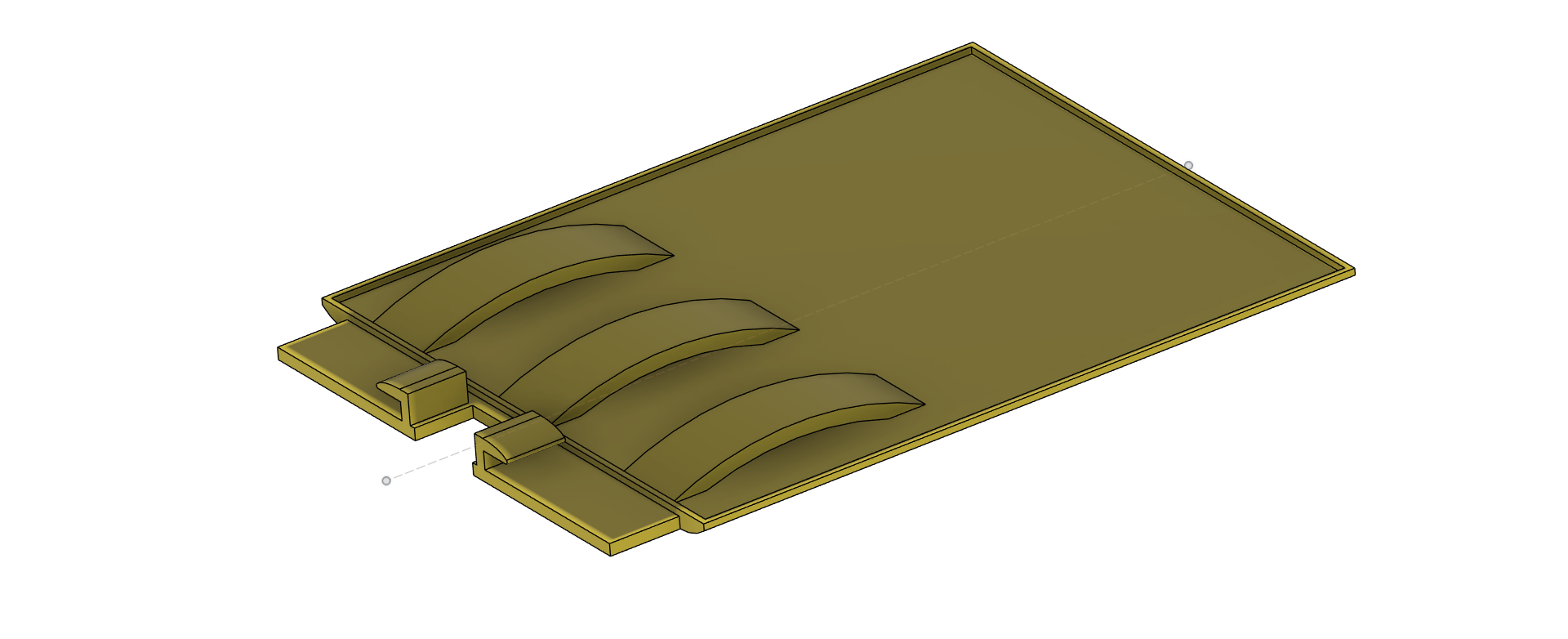
06 — Leaf Springs (×3)

Integrated into door. Provides 9.3 N ejection force at zero additional BOM cost. Dampening O-rings mute impact.

TECHNICAL CALCULATION 01

WEDGE ACTUATION
FORCE ANALYSIS

The user's downward force must overcome the 22.5° wedge frictional resistance sliding against two lateral springs (P=8.0 N combined), plus the vertical return spring preload.

$P$ (Lateral Load): 2 × 4.0 N = 8.0 N
$\alpha$ (Wedge Angle): 22.5° → $\tan(22.5°) \approx 0.414$
$\mu$ (Friction, PC/ABS): 0.25
$F_{return}$ (Vertical Spring): 2.0 N preload
Total Actuation Force 7.93 N
$$ F_{wedge} = P \cdot \left[ \frac{\mu + \tan\alpha}{1 - \mu \cdot \tan\alpha} \right] $$
$$ = 8.0 \cdot \left[ \frac{0.25 + 0.414}{1 - (0.25)(0.414)} \right] = 8.0 \cdot \frac{0.664}{0.8965} $$
$$ F_{wedge} = 5.93 \text{ N} $$
$$ F_{act} = 5.93 + 2.0 = \mathbf{7.93 \text{ N}} $$

To reach the 11.5 N "premium" benchmark, increase $P$ to 12.0 N (6.0 N per spring).

TECHNICAL CALCULATION 02

CANTILEVER STRAIN
OPTIMIZATION

The latch arm must deflect 1.4 mm to clear the chassis hooks. We must prove this doesn't exceed the 2.0% yield strain of PC/ABS Bayblend FR110.

Design Iteration Story

Rev 1 (L=12.0mm): $\epsilon = 1.5 \cdot 1.5 \cdot 1.4 / 12^2 = 3.15/144 = $ 2.18% — OVER the 2.0% limit!

Rev 2 (L=13.5mm): $\epsilon = 3.15/182.25 = $ 1.73% — Safe, with 0.27% margin to yield.

Increasing arm from 12→13.5mm uses 90% of the 15mm bounding box Y-axis, maximizing volumetric efficiency while maintaining structural integrity.

Remaining clearance: 15mm − 13.5mm = 1.5mm for chassis walls + 0.15mm shadow gap
$$ \epsilon_{max} = \frac{1.5 \cdot t \cdot y}{L^2} $$
$$ \epsilon_{max} = \frac{1.5 \times 1.5 \times 1.4}{13.5^2} = \frac{3.15}{182.25} $$
$$ \epsilon_{max} = 1.73\% $$

Safe: below 2.0% dynamic yield threshold for PC/ABS

0.27%

Safety Margin to Yield

TECHNICAL CALCULATION 03

RESET RELIABILITY &
EJECTION DYNAMICS

Reset Click Verification

The vertical return spring must overcome track friction + button gravity to snap the button flush reliably:

$$ F_{spring} > F_{friction} + m \cdot g $$ $$ 2.0\text{ N} \gg 0.5\text{ N} + 0.05\text{ N} = 0.55\text{ N} $$

The spring is 3.6× stronger than the resistance. Preload of 3.4 N (5mm compression × 0.68 N/mm) provides an authoritative, snappy "click."

Leaf Spring Assembly
Leaf Springs Detail
ENERGY DECOUPLING: The cardioid track decouples unlatching from ejection. Holding the door down during actuation doesn't jam — latches remain retracted in "Service Mode" until obstruction is removed.

Ejection Velocity (3-Battery Config)

Conical springs: 3 × 7.78 N = 23.34 N
Leaf springs: 3 × 3.1 N = 9.3 N
$F_{total}$: 32.64 N combined
Door mass: ~0.015 kg  |  Travel: 4 mm
$$ W = F \cdot d = 32.64 \times 0.004 = 0.131 \text{ J} $$
$$ v = \sqrt{\frac{2W}{m}} = \sqrt{\frac{0.261}{0.015}} $$
$$ v \approx 4.17 \text{ m/s} $$

Damping grease on leaf springs converts violent "fire" into a smooth, controlled rise.

TECHNICAL CALCULATION 04

STRUCTURAL INTEGRITY:
SHEAR LOAD MARGINS

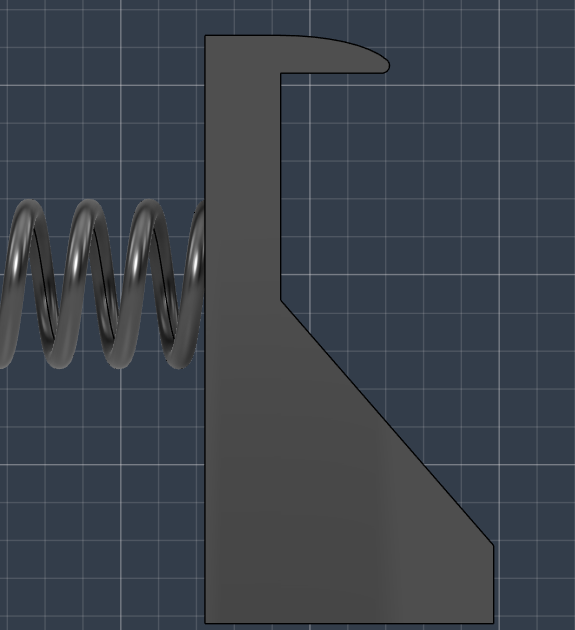
Each hook in the entire model hangs 1.5mm outwards of their stem, which is 2mm wide. The end point of the hook is 0.5mm filleted, and the thickness of the hook is 1.3mm.
Hook Dimensions

Curved Lead-in Advantage

The curved nature of the hooks fits the wedge securely and seamlessly guides the door hooks vertically into place during manual closing. Note: The door hooks are molded thick and rigid, forcing the mechanism's latch hooks to flex outward and do all the dynamic work.

Shear Stress Area = 2.0mm × 1.3mm = 2.6 mm² $$ \tau_{prong} = \frac{7.78 \text{ N}}{2.6 \text{ mm}^2} = 2.99 \text{ MPa} $$
16×

SAFETY FACTOR

PC/ABS yields at ~50.0 MPa. At ~3.0 MPa applied stress, the hooks are practically indestructible in pure shear.

3D CAD [01] MECHANISM
ASSEMBLY
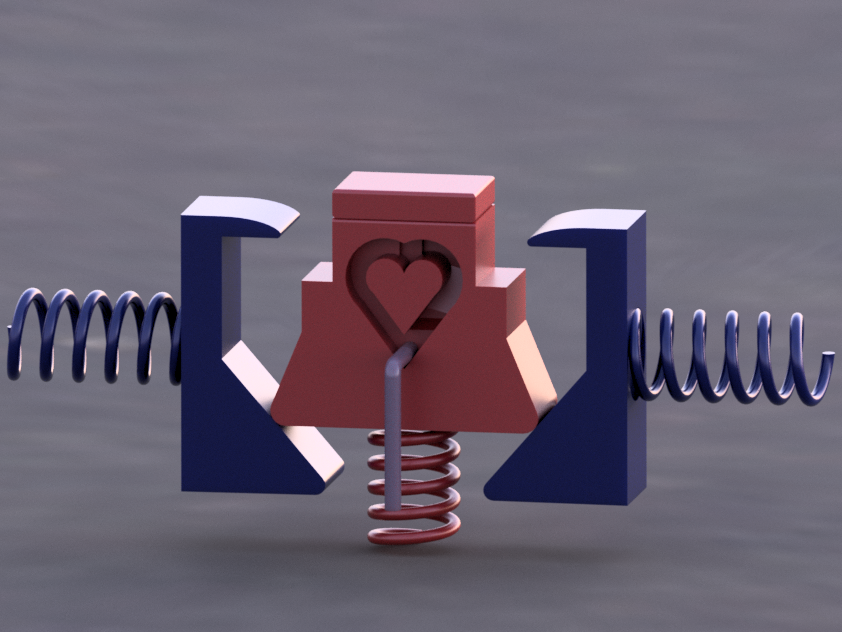
Mechanism Rendered Locked

Rendered Isometric — Locked State

Shows the inverted pyramid button (red) sitting flush. The heart-shaped cardioid track holds the pin in the resting start position. Lateral coil springs fully drive latches inward to secure the door.
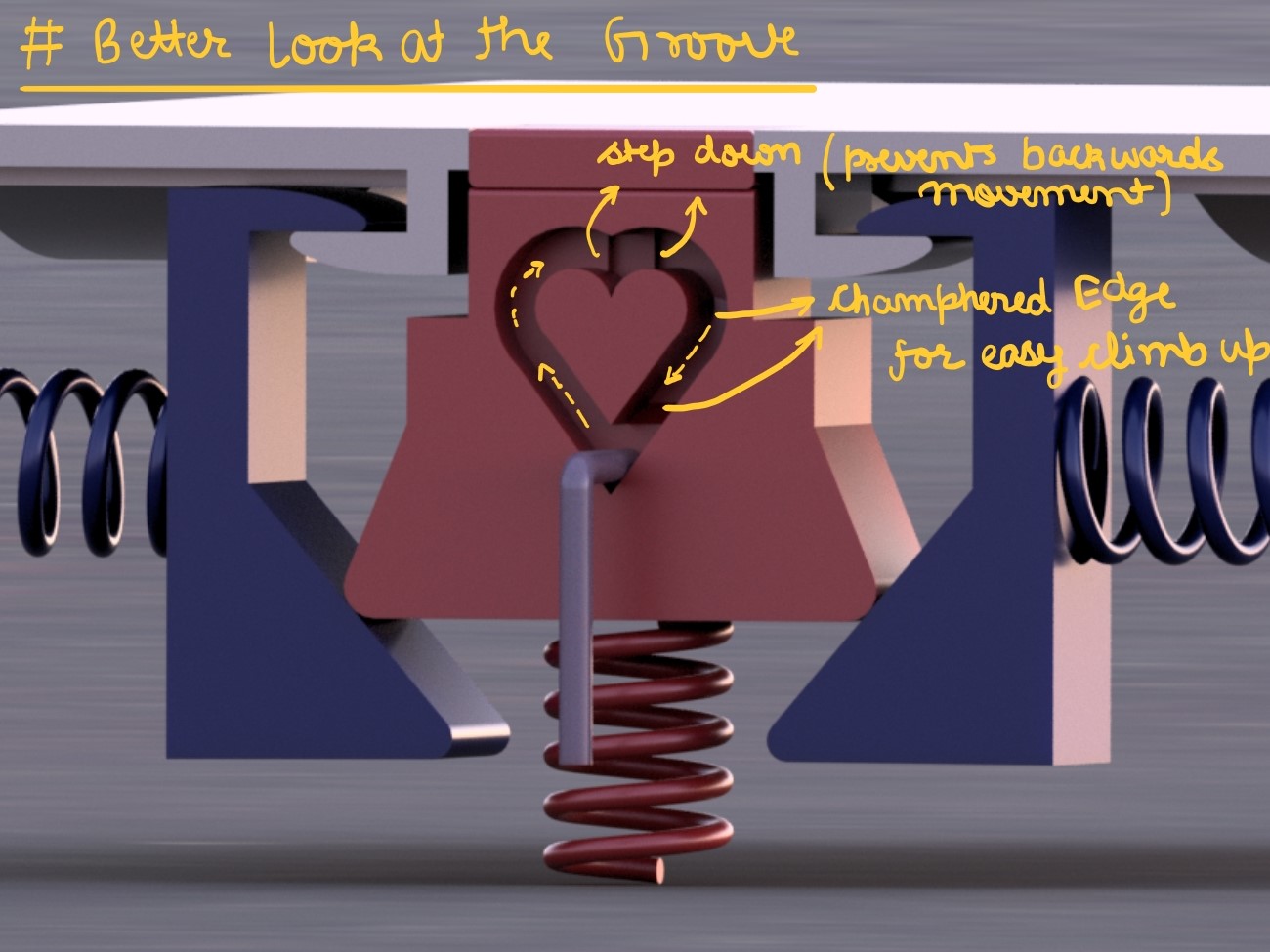
Cardioid Groove Track

The Cardioid Heart-Track Groove

This is the 3D groove machined into the rear face of the wedge button. The follower pin rides through this track. Stepped depths at each valley ensure the pin can only travel forward through the lock→service→eject→lock cycle, never backwards. This is the physical "state machine" that gives the mechanism its bistable memory.

3D CAD EXPLODED
VIEW

Assembly Sequence
Exploded Assembly View

Assembly Sequence (Bottom-Up)

Layer 1: Chassis base with battery contact rails and locating tabs (chassis hooks). 3× conical battery springs pre-inserted.
Layer 2: 2× lateral latches slide into guide channels. 2× lateral coil springs seated against chassis walls.
Layer 3: Wedge button drops into central well. 1× vertical return spring + follower pin pre-loaded. 2× nitrile O-rings seated at well base.
Layer 4: Door panel snaps over assembly. 3× integrated leaf springs provide supplemental ejection force. Total assembly: 6 unique parts, 11 total components.
Locked State
VISUAL INDICATOR:
Button flush = Door Locked.

HOW IT WORKS
LOCKED
STATE

State 1: Resting & Secure

Securing The Mechanism

Relocking (2nd Click): A second press advances the follower pin to the next valley in the cardioid track, releasing the wedge. The vertical return spring snaps the button flush.

Closing the Door: The user pushes the door back down onto the chassis. The curved lead-in on the latch hooks guides the door smoothly past, temporarily deflecting the latches to secure the assembly.

HOW IT WORKS
UNLOCKED
STATE

State 2: Service Mode

Accessing Service Mode

Press the button (1st click): Pushing straight down forces lateral latches outward. The cardioid track captures the follower pin in its "service" valley, holding the button recessed.

Door pops open: With the mechanism retracted, the combined 32.64 N load from the conical/leaf springs pushes the door upward. Both hands are now free to swap batteries.
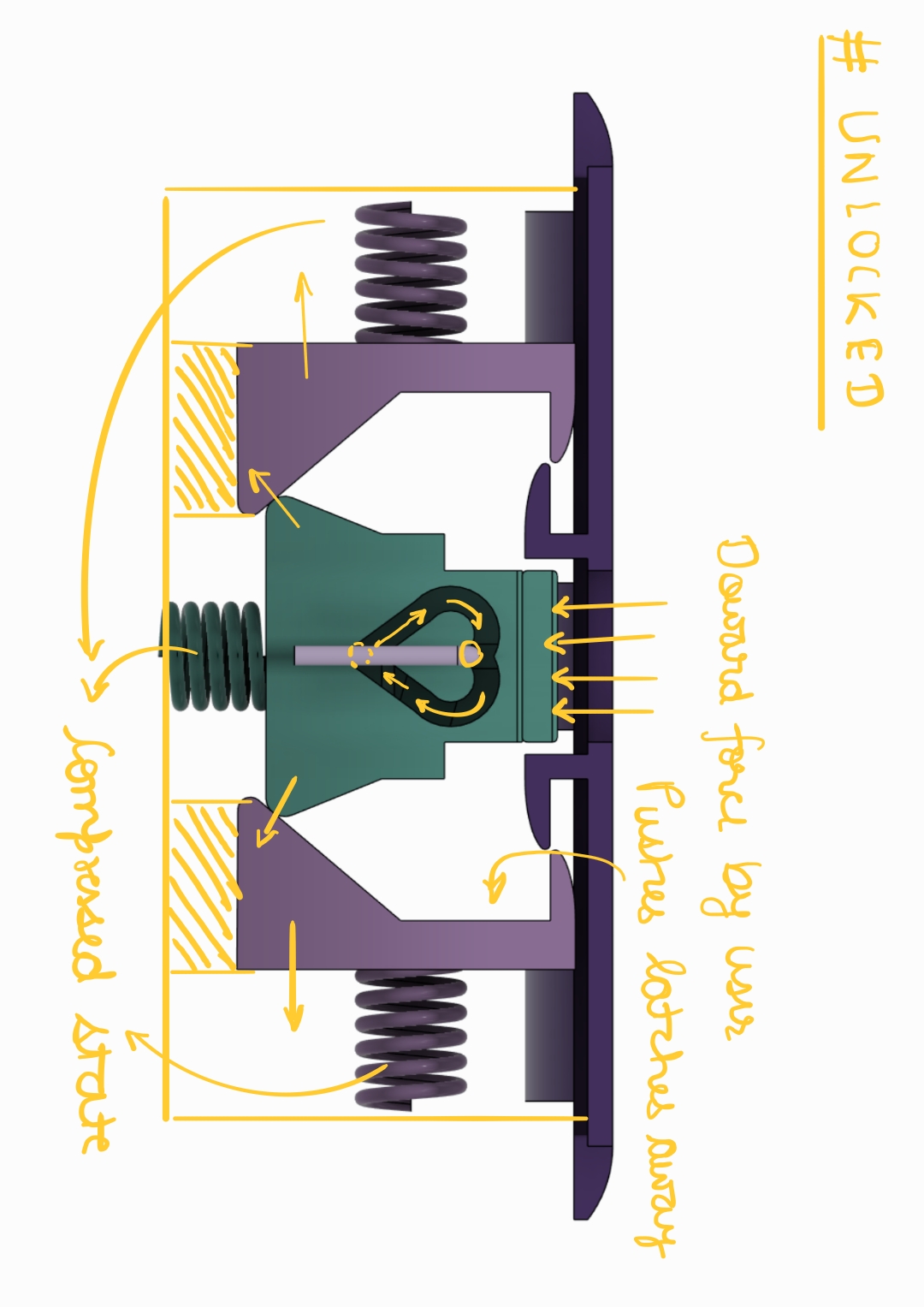
Unlocked State
VISUAL INDICATOR:
Button recessed = Service Mode Active.

PREMIUM
UPGRADES

The Flagship Feel Matrix

Rigid Housing Tracks

To achieve a truly zero-wobble premium feel, we mold precision structural "rails" directly into the chassis. This gives the latches zero room for unwanted displacement during the stroke, preventing any lateral rattling.

Acoustic Engineering

Dual-shot injection molding at the locking interfaces (adding a microscopic layer of elastomeric TPU) completely eliminates the plastic "clack" sound upon closure, yielding a muted, heavy "thud".

Kinematic Dampening

High-viscosity Nyogel grease on lateral tracks converts snappy actuation into a smooth, progressive stroke. Internal X-ribbing on the button lowers acoustic resonance frequency for a deeper click tone.

BILL OF MATERIALS & COSTING

ComponentMaterialWhy This MaterialQtyEst.
Door Block Base10% GF PC/ABSGlass-fill adds rigidity for leaf spring fatigue resistance1₹15.00
Wedge UI ButtonPC/ABS PolymerUnfilled for smooth wedge sliding contact1₹8.00
Micro-Latches10% GF PC/ABSHigh stiffness for 1.73% strain cycles2₹5.00
Coil Springs (Mechanism)High-Carbon Music Wire1× vertical return + 2× lateral bias springs3₹6.00
Conical Battery SpringsHigh-Carbon Music Wire7.78 N each for battery ejection (23.34 N total)3₹9.00
Follower Pin304 SS WireCorrosion-proof for the cardioid track1₹2.00
O-RingsNitrile RubberAcoustic dampening at button bottom2₹2.00
Leaf Springs (integrated)10% GF PC/ABSMolded integral to door — zero additional cost3₹0.00
8 component types, 16 total parts × injection molding = low tooling amortization at volume. Zero fasteners — all snap-fit assembly.
Total: ₹47.00

END OF
STUDY

Mechanism Wedge-Actuated Inverted Cardioid — Bistable Push-Push Toggle
Key Metrics 7.93 N actuation | 1.73% max strain | 32.64 N ejection | 16× shear SF | ₹47.00/unit
Achievement Hands-free battery replacement in a flush, screwless, premium unibody — zero external sliding parts.

Mechanism Validation & Narrative Complete.

21

Thank You

Product Design Case Study | Arya Duhan | Mechanical Engineering

Hint: type ↑ ↑ ↓ ↓ ← → ← → b a
1 / 20
CONTACT SECURED
aryaduhan29@gmail.com

Here are some handmade flowers for you

Handmade Flowers

Have a nice day.

Achievement Unlocked!

"Unemployed?"

You found all the secrets!